Sunday, 22 December 2013

JARLINC's Film Script

        We have been working on our script, and our finished result is underneath this introduction. We found it very hard to create without having any spoken dialogue in our film.

        The point of the film script is to give the production team and the cast of actors know exactly what to do and when. We will give out copies of the scripts to members of the cast to revise and go over, ready for filming on location with the equipment.


Wednesday, 18 December 2013

Our Film Pitch - JARLINC's

        On the 7th of December, me and my group pitched our film ideas to the class. We've came up with the name 'Shadowed' for our film, as it is basically about a young male being followed, or shadowed, by his other personality, as he's Schizophrenic. The film makes out that he is not the one killing, it's someone else, who appears to be stalking him, killing people close to him. It is revealed that it is, in fact, himself killing everyone and this mysterious 'shadow' is actually himself, only his other, darker side.

Below is our recorded film pitch


        A film pitch is where a movie production company (people with the ideas) go and see a publishing company (people with the money) and try to persuade them to have their film made. However; there will be more film companies there, and not all of them will be picked for production, so the film pitch is one of the most important things to get right, it's vital. If all goes well, your film will be commisioned, and if it doesn't... no film for you!

        It starts with Connor, the protagonist, running towards a safe place, his workplace; the science labs. He pulls a gun out when he arrives, breathing heavily and in distress. We plan to make use of thunder sound effects, lights (for lightning) heart beat sounds and footsteps combined to create a very effective and tense atmosphere for our thriller film.

Tuesday, 17 December 2013

JARLINC's Target Audience Profile (TAP)

Neil Evans

        Neil Evans, 16 years old, male. He is in year 12 currently studying AS Media, Music, Physics and English at Great Wyrley High School's Sixth Form. He is an imaginative boy, who has planned his whole future. He's hoping to go to University and further study Media and Music.

        Living with his parents, when he isn't studying, he plays intense sports like Rugby and reads books like 'Murdoch Mysteries', 'Goosebumps' or 'Percy Jackson'. In spare time, primarily on weekends, Neil goes out with his mates and/or his brother to watch the latest film of almost any kind, although his favourite genre types are Horror, Action, Thriller, Mystery/Crime and Sci-Fi. Two of the films he's watched recently are Dorian Gray and Taken 2. He's a fan of older, classic thriller films but doesn't know which is his favourite.

        Neil saves nearly all of his money for the cinemas and buying new books and DVD's for his vast collection, and he does this by working part-time on Saturdays. He also has a University fund and a car fund in his bank account,  hoping to buy a black car; a Bentley or Jaguar, as they're favorite make of car.

        Neil likes music with a powerful, rolling beat that can drown out background noises when he reads or studies. Some of the bands he has albums for are Nickelback, Queen, Black Sabbath and Panic! at the Disco. He also listens to other music from areas such as rock, pop and alternative rock.

Monday, 16 December 2013

Target Audience Research and JARLINC's Target Audience

        Before we finally pick our target audience, we thought it would be wise to go and do a bit of research first, to make sure we know exactly what we're dealing with.

Target Audience Research:

Classification:

The classification (age rating) of a film is something that should never be neglected by film producers. If a film is aged at 12 year olds, but then gets a certificate of 15, then something  's gone wrong. The certificate is given based on the content involved in the film, and the biggest factor is sexual content, closely followed by extreme gore. For example, The Lord of the Rings: The Fellowship of the Ring is a PG, yet Boromir is shot by three arrows in the chest, all of wich are shown, in slow motion just in case the kids miss! Also, there are numerous accounts of decapitations, yet the film scores a PG. Then there's the Inbetweeners Film. I am pretty sure nobody is decapitated in that film, yet the certificate is much higher because of the degree o sexual behavior.
        All of the factors are put together and discussed by members of the British Board of Film Classification, or BBFC for short.

The BBFC:

        This is an official organisation who tests films and gives them the appropriate certificate. They all watch the film and note down what they think, and then after official meetings, elect a certificate for the film. Below here is a list of the possible certificates, with a summary of each:


  • UNIVERSAL
  • Films are appropriate for viewers of any age, hence the name 'Universal'.
  • Sexual behaviour is kept to a minimum, with little more than a kiss involved.
  • Subtle language can be used, but no swearing is acceptable.
  • No drug use of any kind. No exceptions.


  • PARENTAL GUIDANCE.
  • Films are appropriate for children if any age, so long as their parents allow.
  • Sexual bevaviour is strict and must be minimal.
  • Drugs are sometimes shown in PG rated films, however, they're kept to a small standard.
  • Drinking and smoking is acceptable to an extent.


  • TWELVE
  • Violence is shown in more detail, but must be closely checked.
  • Sexual violence is shown sometimes to an extent, but must be justified.
  • Drugs are present but in small portions, and nothing major.
  • Sexual behaviour can be shown more clearly, but still must be checked. Subtle nudity allowed.
  • Aggressive racist or homicidal language is not acceptable.
  • Mild swearing is accepted, but not too frequent.


  • TWELVE ACCOMPANIED
  • A 12A rating follows the same rules as a 12 age rating - only this is the age rating used for cinemas, and requires children under 12 to have an adult present, and most 12 year olds are with adults at the cinemas anyway.


  • FIFTEEN
  • Aggressive racist or homicidal language is acceptable.
  • Drugs are able to be seen clearly, storylines may revolve around them.
  • Sexual violence is allowed, although in small amounts and maybe in limitation.
  • Strong violence is allowed.
  • Stronger language used more frequently is acceptable.
  • Sexual nudity is allowed in more detail.


  • EIGHTEEN
  • Very strong language allowed.
  • Heavy amounts of blood, violence and gore allowed.
  • Intense sexual scenes allowed.
  • Drug use is allowed to almost any level, but is still used in moderation... most of the time.
  • Extreme racist and homophobic behaviour is accepted.


  • RESTRICTED EIGHTEEN
  • These films are only allowed to be televised at specially licensed cinemas.
  • Specialist category, restricted classification for explicit materials.

JARLINC's Identified Target Audience

        Piecing all the information gathered together, we came to a conclusion of giving our film a certificate of 12/12A. This is because children below the age of 12 may be affected by trauma of the film, as elements of horror is involved and incorporated into the film.

Age of Target Audience: 12+

Gender of Target Audience: Both sexes, but most likely male.

Ethnicity of Target Audience: West European/English speaking countries.

Education Level of Target Audience: Year 11 and higher

Genre Preferences of Target Audience: Thriller, Horror and Action.

Thursday, 12 December 2013

Role of a Sound Editor Research

        The sound editors are members of a film production team that specialize in the audio of a film. Audio in films are split into three main categories, these are: dialogue, music and effects. Some highly skilled or experienced sound editors specialize in one of them three categories, overall improving the audio quality because everyone is better at their job as they have only a smaller part to focus on, also improving speed of production.


        Sound editors can also work in other areas of the Media, like radio stations and video games. These are slightly different, but essentially do the same thing; edit sounds! As I mentioned above, there are three categories of sound:

Dialogue
        The dialogue is the speech of characters. The sound editor can cut and trim the files, and change the audio volume to match the other audio in a film; you don't want a character's whisper heard clearly over an explosion! The dialogue is a fairly straight forward audio aspect, because the actors do most of the work, and all the dialogue editor has to do is look after the files, trim them and position them onto the sound file.


Music
        The music is probably the hardest audio to edit. This is because the transition between tracks when the on-screen footage changes can be hard to match carefully, and it is not hard to make the sound appear to jump. For example, if it's a bright sunny day, and then suddenly someone pulls a gun out of their pocket and shoots someone, then I doubt it will be playing Fur Elise in the background. Matching up the backing tracks to the film can be extremely challenging, so these are among the most skilled sound editors.


Effects
        The effects are some of the more basic sounds to edit. Making sure they fit in and are positioned correctly is vital; seeing an explosion before the sound appears in obviously unacceptable, unless, of course, it's a distant volcanic eruption, lightning/thunder or something like that, because light travels faster than sound, so the audio would appear after the visual effects. This is something all effects editors must consider, as it's really easy to not do it right.


BEFORE SOUND IN FILMS
        Films before around 1930 were nearly all in complete silence, which obviously means sound editors didn't exist. They were considered a scientific revolution back then, but with the invention of sound and colour television, it was almost unbelievable.
        The most famous filmmaker in the early 20th century was Charlie Chaplin. His films were almost all silent, and he made a large variety. In those days, the cameras were gigantic pieces of machinery and were not moved once recording started.
        With the invention of sound, the sound editor was born. They were proficient, and their numbers grew rapidly as the film industry became more popular. Sound editors were also used in the production of patriotic films, like advertisements such as 'Join your country's army!' *god save the king* and so forth. The sound editor has became a key element of any filmmaking crew and production team.
        In the early days of film, there were no production companies as such. They were usually presented under a name, for example 'Charlie Chaplin'.

Charlie Chaplin

Foley and Dubbing

        Foley in Media is the creation of sound effects that are recorded separately to the video and added in during post-production. Some of these include doors closing, wind howling, glass smashing and people knocking on a door. The purpose of them is to make the sound able to be edited and in this way the sound editor can make sure the sound match up to the video, and to make sure the sound effect is clearly heard. The perfect edit will make sure the foley effect is realistic to the video, and the viewers believe it is a diegetic part of the film.
        Foley is usually created with everything you can think of apart from the actual thing it's creating. For example; the noises of the sliding automatic doors in Star Trek are just pieces of paper slipped in and out of an envelope to symbolise the hydraulic noise of the doors. They can also be used to cover up the sounds that are actually recorded, which is down to the sound editor.

        Dubbing is another process in sound in the Media, and it is created by removing the original audio of the film and replacing it with a edited version to make it sound better. This is used all the time in musicals, they record the sound there to make sure it will fit, then create a studio recording and overwrite the previous sound, to make the audio sound perfect.

Class example of foley sounds

        In groups, we took it in turns to attempt to create foley sounds with a variety of everyday things, like flour in a box, a pink scrunch and a rolled up newspaper. We used these to create the following sound effects:

        A Cat Purring was created without using any equipment. Instead, we got a member of our group to make a cat purring noise using their tongue close to the sound recorder.

        A Punch was created by using the rolled up newspaper and hit somebody on the arm to make a thump sound that, especially on the sound recorder, sounded much like a genuine punch.

        A Walking in Snow foley sound was created by using the flour in a box and the scrunchie. By placing the scrunchie into the flour and squashing it with a stick, it allowed us to record a sound identical to walking in snow.
THE FOLEY SOUNDS WE CREATED:

Role of a Music Composer in Film

        I will now talk about composers in the media, and my chosen example is Howard Shore, who composed the music for Peter Jackson's Lord of the Rings trilogy. The role of a film music composer is to write and perform unique tracks for the film. Most of these are non-diegetically added in, but some are actually played diegetically on-screen, mostly during scenes in very expensive restaurants, or, like in James Cameron's 'Titanic' film, on the deck of a huge sinking cross-Atlantic steamer! Musical compositions that are unique to a film, like the Star Wars theme, bring a film to life. The start of Iron Man, AC/DC's Back in Black is played. Okay, it sets the scene, but has no personal character to it. When properly composed, film musical tracks can really boost the popularity of films, as people want to go and see the amazing compositions people make! Howard Shore has received 63 awards and 55 nominations.

Howard Shore was born in Toronto, Canada on October 18th 1946 and has has scored music for over 80 films, and so below is a select list of films Howard Shore has composed music for:
  • Big (1988)
  • The Silence of the Lambs (1991)
  • Mrs. Doubtfire (1993)
  • That Thing You Do! (1996)
  • The Lord of the Rings Trilogy (2001-2003)
  • The Twilight Saga: Eclipse (2010)
  • The Hobbit Trilogy (2012-2014)
        Below here I have embedded a few videos of Howard Shore's compositions. Personally, I like any of the soundtracks from The Lord of the Rings, but I have no particular favourite. My preferred three are Concerning Hobbits and the themes of Rohan and Isengard.

Concerning Hobbits

Rohan's Theme

Isengard's Theme

        The way that Howard has placed a heavy contrast between the music helps put a more in-depth character and personality to the regions of Middle-earth in The Lord of the Rings. The film starts with a light, cheery song (my first embedded example - Concerning Hobbits) and moves on to a heavy song (the third example - Isengard) when the tide turns against them. The outstanding contrast between the places of the world in The Lord of the Rings is extremely well-done in the musical aspect of things.

The Wilhelm Scream

        The Wilhelm Scream is a member of a 'family' of sounds known as 'Stock Sounds'. This particular one was first used in 1951 and was (is) very famous. It has been used in many key films, and has existed in over 250 films worldwide. Two examples are the Star Wars films and The Lord of the Rings trilogy, and I've embedded an example below. The Wilhelm Scream is at 0:59.

Sunday, 8 December 2013

JARLINC's Film Narrative Discussion (pros and cons)

        After coming up with the genre our group chose for our coursework film, we started brainstorming ideas for our storyline. We discussed a few before coming up with our final choice, but all the ideas we did come up with were all linked.

        The main thing we needed to do was come up with a main idea. This was to have one protagonist and one antagonist. We thought up of them both, and decided upon the antagonist first. He would wear fully black clothing to give off an imposing and intimidating look. He stayed mostly the same for all of our film story ideas, with a few adjustments, like trying to cover his face with his hood. We decided that he would keep to the shadows, and that is where our film name came from. A dark shadowy figure following a protagonist; 'Shadowed'. We thought up his name. Not mentioned in the film, it wasn't really important but we needed to make up a name so we had something to refer to so we knew which character we were talking about, and it made it possible for the script to be made.
        We then started characterising our protagonist. We decided upon making him a scientist, as that's a stereotypical good guy job. Subverting this can give an evil mastermind scientist idea, but we kept the standard for our protagonist. We opposed the antagonist by dressing him in white, a lab coat, to make it easier to distinguish between them. The name for our protagonist came from my middle name, as this relates to us. Connor, the protagonist, would be running from this shadowy attacker, Seth (the antagonist). His 'good guy' interpretation would be subverted when he finds the gun in the science laboratory.

        We were discussing which way to end our film, whether to have Connor, the protagonist, kill Seth, the antagonist, or have it the other way around. We settled this by coming up with the idea of not telling the viewers which character kills the other, and we did this by having them encounter each other and having them both raise their guns. The screen would go black and then a gunshot would sound, which would mean nobody knows who killed who, but the last thing the viewers see is Seth's smiling face, which may tell them he is the one that kills Connor because he is enjoying it, and Connor is afraid.

        One of the last things we came up with, was to make them related in some way. We decided we would have Seth acting as Connor's other side, his split personality, just physical. So, if Seth kills Connor, Connor is essentially killing himself. Connor's schizophrenia is not presented very clear, but is a way of understanding Connor's confusion and the fact Seth gets through locked doors; he simply isn't there.

Pros

1) No special effects or props will be required, as it is set in the present day.
2) We only require two actors, which will make it easier and reduce risk rates, as there's less people to get hurt.
3) As with the first pro, we don't need to go to extreme lengths to find the costumes for our characters, and there's only two characters we need to find costumes for.

Cons

1) The lightening effects will be hard to execute using the lights.
2) Our film idea requires us to film in the dark, as this improves the effect of our film.

Wednesday, 4 December 2013

Early Consideration of Evaluation Questions

The next step is thinking in advance about what questions we will need to answer in our evaluation. We discussed these thoroughly, and wrote down some answers for the questions.

Below are the questions we are considering:


  1. In way way does our media product use, develop or challenge forms and conventions of real life media products?
  2. How does our media product represent particular social groups?
  3. What kind of media broadcasting company might distribute our media product? Why?
  4. Who would be the target audience for our media product?
  5. How did we address our target audience?
  6. What have we learnt about technologies from the process of producing our media product?
  7. Looking back at our preliminary task, what do we feel we have learnt in the development from it to our finished media product?

My production team and I addressed these questions, and below is our conclusion:


  1. The idea of our film challenges the thriller convention that there's one protagonist and one antagonist. We subvert this convention by making the protagonist, Connor, also the antagonist, Seth, by being schizophrenic, having a split-personality. We also use connotations of the colour black in our film, as Seth is dressed in black and is evil, mysterious, dangerous and scary, as black is dark and people are afraid of the dark. At the end of our two minute minute film, we want the viewers to think that Connor is shot by Seth.
  2. The film challenges social groups by Seth, the antagonist, being dressed in all black; hoodie, jeans and boots and Connor, the protagonist, being dressed in white. Seth's costume set up is very similar to that of a modern day 'chav' and so says that their social group is a trouble-making evil lot. Connor is shown to be a normal scientist, until he finds the gun in the laboratory. This subverts his social group, as he knew exactly where the gun was hidden and was pleased when he found it.
  3. It is most likely that a small or developing distributor company which has not really been heard of, as this is the most likely company to accept us, as we're a newly formed production team with little experience, therefore probably creating less successful films.
  4. We originally came to the decision to make the target audience 15+, but later changed that to 12+ to give a broader viewer range, and it's not really horrific enough to be rated 15. What's the point in targeting a rated 12 film at 15 year olds?
  5. The content of our film will most likely attract males rather than females, and people interested in tense films. This is because there's a variety of jump scares and suspense, attracting that sort of target audience.
  6. We haven't used much of the more advanced camera hardware, and so we've planned to use the tracking dolly, tripod and disco dolly. We have had a growing amount of experience with the editing software, and we all focus primarily on different, parts. We are all capable of different operations, but getting each group member to become more familiar with certain elements (such as sound editing and using final cut) because that way we can all work at the same time on different pieces, and then come together for the final adjustments.
  7. The three films so far this year (The Western, Preliminary Task and Chess Film) have granted us the vital skills and experience we'll need to make a final film. The Western helped getting familiar with the camera equipment, the Preliminary Film got us more familiar with editing techniques like match-on-action, and the Chess Film just refreshed us with how the equipment is staged, and let us put the terms into practice, such as 180 degree rule and so forth. On a whole, the Preliminary Task was the most important piece in the way of helping us get to grips with the filming techniques.

Monday, 2 December 2013

JARLINC's Production Team Name

        My group and I, Deanna . Hopps, Daniel . Springthorpe, have been coming up with different names for our production company, and we started playing with our names. By combining all the beginning letters of all our names, we came up with: JARLNC. We then decided to add a 'I' in between the 'L' and the 'N' to make it easier to say, and so our production company name is JARLINC Productions.
        We have also been discussing our Film Ident. After a long discussion and debate about the many different ideas we threw at each other, we combined a number of ideas and came up with a jar tied up in chains, and it bounces around and then a dragon flies out of it, and breathes fire into the screen, burning the letters JARLINC into the jar.
        Our production company name JARLINC reflects our own personal values because, simply, it's a jumble of letters from our names. Here is a break-down:
J - From Daniel's middle name Jack.
A - From Deanna's middle name of Amy.
R - From Deanna's other middle name Rayetta.
L - From Deanna's other OTHER middle name of Leah.
I - Added letter to make the word possible to be pronounced!
N - From my middle name of Neil.
C - From my middle name of Connor.

        We decided to use this method because we wanted to be able to relate to the name, which would have been almost impossible with a name like 'Epic Studios' or 'Production Pros!'
        We wrote down the first letter of all our middle names (6 between us) and started playing around with them, putting them in different orders. We found it hard to make a word out of it, so we decided to cheat and add a letter, the 'I'.

Chosen Colours
        We have came up with two possible colour schemes. The first is red. It is an effective colour, and contrasts well with black, giving a thriller-like connotation - black for evil maybe and red for blood or gore...?
        The second idea we thought up of is a more silver and gold related scheme. This will be more gentle than the red and black, and will be more fitting to our film than most other colours. They reflect our values because we all like silver and gold, and all agree that they can go well together.

Logo Design
        We chose a dragon, but may need to change around with that if it's too hard to get hold of. We chose this and it reflects our values because we are all interested in the Medieval era and creatures from legends, like dragons, and Deanna is especially fond of mythological creatures.

Saturday, 30 November 2013

Thriller Opening Deconstructions

Thriller Deconstruction 1: Van Helsing, 2004

Film Ident

1
00:00:00 - 00:00:08
The change between the coloured and greyscale versions of the Universal ident tells the reader stright away that the film is set in the past. Note the soundtrack over the ident, this attracts the reader because they want to find out what is happening to make the ident change to greyscale.

00:00:08 - 00:00:15
2
00:00:15 - 00:00:18
Fifteen seconds in, the Universal logo combusts and is covered in fire, this shows the force of destruction that is happening in the film, and introduces it better. Three seconds later, the flaming earth is turned into a torch that a member of what appears to be an angry mob is carrying.

Film Begins

00:00:18 - 00:00:22
3
00:00:22 - 00:00:25
A crane shot is used in this shot, revealing to the viewer the sheer amount of people in the angry mob. A mob of that size will cause heaps of destruction, and so affects the reader by making them wonder what's happened to make so many people so angry.

4
00:00:25 - 00:00:27
This mid shot used shows the peasant's costume: dark clothing, presumably black. Just after the shot shown above, the peasant runs off in search of his destination to cause more terror.

5
00:00:27 - 00:00:35
In this space, a battering ram is smashed into a huge pair of wooden double doors. This shows the viewer that the mob is well-planned and outfitted, and maybe have known their 'enemy' long enough to know what they need to do. As the gates burst open, there is a POV shot from a peasant's eyes, and a line of text reading 'Transylvania 1887'. This text immediately shows the viewer why the film is in black and white in low key lighting. And then there's the place name. Transylvania is an area in Romania, and is historically said to be home of the vampire Count Dracula and the scientist Victor Frankenstein.

00:00:35 - 00:00:40

Scene location changes to castle interior

6
00:00:46 - 00:00:47
The extreme close up shot of the eyes is a very effective shot. It shows the character's emotions, in this case, shocked, and also what gender they are. Close ups of eyes can be used in different ways, like building tension of shocking the viewer, like this shot does. The eyes are surrounded by bandages, which shows something about the character. Everyone knows the story of Frankenstein, and with the film set in Transylvania, it kind of gives it away; he looks unnatural.

7
00:00:47 - 00:00:48
If you can't work out what's shown in the image, it's a hand. It is shown straight after the extreme close up of the eyes, and has a similar texture. Also, the hand is struggling to get free, but is strapped down. This ties together with the wide-eyes the last image shows, and so this character must be confused and trapped.The hand looks unnatural, just like the eyes. It is kind of 'zombie-ish' and so hints to the viewer that the creature is not really alive.

8
00:00:48 - 00:00:50
Another extreme close up. The close shots of this character show that the character is trying to be shown in small; sections instead of a whole, which builds tension by making the viewer think 'well who is it then!?' The creature screams loudly, going hand-in-hand with the wide-eyes and struggling hand by saying the character is in a very uncomfortable position.

9
00:00:50 - 00:00:57
Nearly a minute into the film, the viewer is shown another character. Many of the information of the character is kept away, just like with the creature, and so for now we'll have to go off small parts. Take the lab coat. Stereotypically and functionally used by scientists and other professions like that. We can assume, along with the erquipment in the room, he is a scientist. Now looking at the rest of the setting, the viewer can see the equipment the scientist has at his disposal, and shows that he is specific and significant. This character is in a castle-like environment, and so now the viewer is told who the mob is angry at: the scientist. The character turns around and repeats the two words 'It's alive!' three times. This shows the viewers that he has successfully bought something back to life, or granted something life. He looks kind of surprised in himself, which is kind of stereotypical of scientists in thriller film because they always seems to doubt themselves. Then shot answers many questions, and is a key moment.

10
00:00:57 - 00:01:02
The scientist just finds out about the approaching mob. As you can see in the photograph above, he looks shocked. Worried. The reaction shot used shows the viewers that, maybe, he wasn't expecting them to stand up to him.

Scene location changes to exterior

11
00:01:02 - 00:01:04
I am pretty sure this is meant to be a POV shot from the scientist's window, looking down at the enormous mass of angry peasants. This shot is used to show the viewers exactly what he is looking at and why his reaction was how it was, although the viewer knew what was happening before the character. This is known as dramatic irony.

12
00:01:04 - 00:01:06
The shot used here can be one or both of these two things; a POV shot and mid shot. The shot it self is mid, as it shows around half of the characters' bodies, but the way the camera is positioned and the placement og it suggests a kind of point of view of the gate, as it fends off the attackers. This ties in with the scientist bringing that creature to life, as the gate is given a personality.

13
00:01:06 - 00:01:08
This over the shoulder shot depicts a kind of POV shot because we can clearly see the shiluette in the left window that he's looking at. After this shot there's a crane shot of the mob and stops at the leader, and he points towards the window and shouts 'There he is!' This shows that the scientist has definitely done something to wrong these people, and they want him for it.
14
00:01:08 - 00:01:09
Shortly after his shouting 'There he is!' the mob leader yells the order 'Hit it again!', and this is portrayed in a close up shot of him face. This shows the high determination they have to get to the scientist. This character alone is everything bad, showing that the scientist may be a good guy. His blackened eyes show intense anger, and so it appears he is trying to kill the scientist. The rotting teeth here may suggest that he is lower class, and also, villains tend to not take care of themselves, whereas the heroes do. His uncut, untidy hair also may suggest his status, proving him to be lower down like working class. It also shows that he takes little care of his well-being, which is something heroes tend to do so shows he's a villain.

15
00:01:09 - 00:01:11
This is another shot representing the gate's point of view. Looking carefully at the tip of the ram, you may notice that the log isn't straight, which means they must have sharpened it for extra power. This shows the viewers that the mob is well-planned and thorough, which says the scientist must have been annoying them for a while as they've got this piece of equipment; nobody has a random sharpened log in their back garden, so they must have made it for a specific purpose. The whole opening to this film is, in spite the fact it was made in 2004, in black and white. This shows the historical feel to it, and makes the viewers know instantly that the Count Dracula/Frankenstein tales are put into reality here. Films are generally scarier when in black and white, and this is no horror, but the thrill in this is improved by the black and white.

16
00:01:11 - 00:01:13
If you can't make out the picture above, it is an overhead shot of the angry mob smashing another gate with their makeshift battering ram. The volume of noise in the shots of the mob and the times is flicks back to it show what's happening and if the scientist will escape them, they're definitely trying to kill him. It shows the pursuit by flicking between the scientist and the mob.

Scene location changes to castle interior

17
00:01:13 - 00:01:14
This next reaction shot is similar to the one in picture ten. It shows the scientist's mood, fear and shock. This is because it appear to the viewers that he knows what he's done, and now they're coming to take his life for it. Also, notice the sweat on his brow? That is probably not out of heat, it's nighttime. It is probably from stress or panic, and he is looking down at the approaching horde.

18
00:01:14 - 00:01:15
This cut follows on from the scientist's reaction shot, and he steps back from the window. Notice how he stays facing the glass, as if he's trying to keep an eye on them because if his back is turned, anything can happen. One minute and fifteen seconds in, the scientist turns around and bumps into a new character.

19
00:01:15 - 00:01:28
As soon as the scientist sees the new character, he immediately tries to get away. The fact that the character is just stood there shows he is not a part of the mob, and he doesn't appear entirely hostile at this point. One minute and twenty-one seconds in, the identity of this new comer is told with the scientist's quote of 'Count, it's only you' shortly after the count shouts 'Success!' which is strengthened by a flash of lightning on his face. This two shot depicts the newcomer as a higher class, because he is positioned taller and is calmer, the other showing fright towards him. The count is calm, and speaks in the Romanian/Transylvanian accent that we're all familiar with, has sleek black hair. The count is dressed in black, a convention of a thriller film. The features of the character all point to one thing; Count Dracula, a vampire. The audience who haven't heard of the legends of Count Dracula may not realise who it is, but the clothing still suggests he is a powerful villainous character. The word 'Success!' leads the viewers to understand that maybe the scientist has finally got it to work, which links back to him being surprised when the creature comes alive. When the count says 'I was beginning to lose faith, Victor' this has two meanings. One, the scientist's name is shown; Victor, which fits the Frankenstein books. And two, that the count has had the scientist on the mission to get the creature alive for some time, and maybe the scientist isn't a bad guy but the count is, and is making him do these things because Victor is the only one with enough power to do so.

20
00:01:28 - 00:01:39
There is a large space between the count and Victor, which may show that Victor is afraid of him, and that's why he's backed against a table with the fear of god in him. The count, however, is not even slightly bothered by the mob outside and isn't even looking at Victor, which suggests maybe Victor is not even a slight threat to him. As the count comes closer to the camera, a pedestal shot is used, raising up to the count's face as he says 'Pity your moment of triumph has been spoiled by a little thing like grave robbery.' Now we know what Victor, the scientist, has done; robbed graves, which suggests that the creature is made from separate parts of human remains. No wonder the mob are after him, that's disgusting. The count doesn't sound serious about him saying 'Pity...' because there is no emotion shown, which also ties back to vampires. He does, however, seem bery interested in what Victory is doing.

21
00:01:39 - 00:01:53
Here the viewers see the scientist Victor running to collect a few items, saying he must escape. The count is standing at the window, not moving. The direction Victor runs in almost directly away from the count, so this shows that the count has higher authority. The scientist has finally buckled under the pressure of the mob and so is panicking about them getting to him. The thriller convention of high tension is kept in play, as everything the character's say, do or see is important. Also, we still don't know the count's real identity, unless you've guessed already. The end of the cut shows the count appearing on the bridge in the blink of an eye, showing that he's powerful and unnatural.

00:01:50


00:01:51
The two photographs above are part of cut 21, but are significant. The count's true colours are shown here, him definitely not being human. The creature is only shown for a frame or two, but reveals the shocking truth behind the count. When I paused the film, the creature was actually quite frightening; I didn't imagine it to be so vivid for only been shown for a fraction of a second. This is a jump scare, a loud flash of lightening and a scary image. This is a convention of thriller films, as it gives the viewer a thrilling moment.

22
00:01:53 - 00:01:57
The scientist Victor is running around gathering his supplies, and is talking. He says 'I'll take him away. Far away, where nobody will ever find him.' This shows the scientist having pride about his 'work' although being horrible, and may also show Victor's fatherly side, meaning he isn't really the bad guy here, just a scientist doing what he's told. Victor refers to the creature as a 'he', showing that it has a personality, or at least it does to Victor.

23
00:01:57 - 00:02:00
Another reaction shot. This one is used when the count is walking behind him, when Victor is rummaging through a container finding his valuables and equipment he wants to take away. The count answers what he said before about taking the creature far away with 'Oh, no, Victor.' Then Victor turns around with a look of horror on his face, which is where this photograph is taken. This then releases the question why does the count want the creature, and what does he want it for? Clearly nothing good.

24
00:02:00 - 00:02:01
In this shot, the viewers are told the real reason why the count is there. He wants the creature. This is put across by the count saying 'The time has come for me to take command of him', which says he is going to take him away himself. He is definitely the villain here. The way he says '...take command...' shows that he thinks of the creature as a tool or soldier, rather than a living thing. The high amount of vocabulary the count uses is typical of upper class people, and so the count appears this way, proving his authority over the lower class people, such as the scientist.

The end of the two minutes

Friday, 29 November 2013

22 Stories

        The 22 stories is a chart of basic story lines or narratives that every film will fall into. Media officials believe that 22 is the maximum limit and no more different narratives are possibly made.

The 22 Stories Table

Thursday, 28 November 2013

Choosing a Genre to Work With

        It didn't take long for me and my group to come up with a film genre idea. We chose thriller because it's simply the easiest and most fun! With comedy, you have to really try and get the right actor, and writing comedy scripts can be extremely challenging. Whereas with thrillers, anyone can look scary in black clothes in the background with the lights off, and not even have to say anything! Plus we agreed we personally find it much more fun to create thrilling films.
        In class, we all got together and added different pieces of information to a spider diagram on a selection of genres, and we thought up conventions, examples, pros and cons. With all the collected evidence in mind, we decided upon our final genre choice; thriller. My group and I came to the decision to add elements of horror into our thriller-based film, to give a more upbeat feel and increase tension. It also relates to us and our values, as we thought making a horror-like thriller film would be more interesting.

Below is a piece of embedded media containing the results we collected in class about genres.

Monday, 25 November 2013

Advanced Camera Techniques: Manual Focusing

        Manual focusing is the action of rotating a wheel or pressing a switch to change the focus length, which is how far away the objects to be in focus are, like 2.5 meters. Moving the focus to or from the foreground to or from the background is called a Focus Pull.
        Moving the focus from the background to the foreground makes things closer to the camera easier to see and the objects further away more blurry. This process allows the cameraman to reveal distant objects or characters at the expense of clear close up figures.
        A good example is the victim sitting by a window in a cafe with what's outside the window blurred. The focus pull focuses the background and makes the foreground (victim) blurred. It is revealed that a stalker is standing over the road, staring at the victim. This is a very effective way, but also common.

THIS IS MY GROUP PERFORMING A FOCUS PULL

        Depth of Field - (DoF)

        The DoF is the section of distance in which the objects will be focused, such as a depth of field between 2.0 meters and 2.5 meters will focus clearly on object in this region, whilst objects closer or further away won't be as clear and appear blurred. This is a diagram to show more detail:

File:Depth of field diagram.png

Sunday, 24 November 2013

Advanced Camerawork: Crane Shots

        A Crane Shot is where the camera is mounted on a crane or such piece of equipment, and is raised up and around in the air. This shot gives a large area of view, showing lots of things at once. It is effective in scenes where there's a lot to see, like in battles, and is also used a lot in openings and endings of films, particularly older ones.
        Below here is a video of my media group performing a crane shot:

Tuesday, 19 November 2013

UK Film Distribution Research

        In my media lesson today, we discussed how films were distributed in the United Kingdom. Click here to see the website we used to research our films.
        We also watched a video explaining what film distributers actually do and how they affect a film's fame to the public.

http://www.launchingfilms.info

Example 1:- The Mummy

The Mummy

        I searched for 'The Mummy' in the website engine and then embedded a part of the results above to show you some details. As you can see in the picture, The Mummy was distributed by Universal, a very popular and successful distributer, possibly saying that the film had high standards as a company as big as Universal will only take on high quality films, as more money and fame will be made.

Formats The Mummy was distributed in

Example 2:- The World's End

The World's End
        I also searched for 'The World's End' - or rather, 'World's End, The' - and this is what I found. It was a successful hit, and made instantly famous by it being related to its predecessors Hot Fuzz and Shaun of the Dead. Again, it was distributed by Universal, probably because it was an award-winning money-making hit, like most other film's distributed by Universal.

Formats The World's End was distributed in

Monday, 18 November 2013

Film Ident Research

        A Film Ident is a symbol - like a logo - which is used to represent a company or studio, which usually pops up during the beginning credits of a film. For example, below I have used the New Line Cinema ident as seen at the start of The Lord of the Rings: The Fellowship of the Ring:


        The idents at the beginning of films are shown as animations, like the stars around the mountain for Paramount's ident, and the jumping lamp for Disney Pixar.
        There are many famous idents out there, if you look. Examples of these are Paramount, Warner Brothers and the Disney Pixar ident, shown in a short clip below. I think the Disney Pixar animated ident is effective because it is unique - nobody else uses a jumping lamp so now they have a signature ident which will be only used by them, meaning every time it is seen, the viewer will link it directly back to this with no problems.


        The Pixar Studios ident is effective because it is childish, and so reflects the films that the company produces. A more adult-based ident would be more interesting or loud, like that of Universal or 20th Century Fox, which have more 'grown up' music and are not really interesting like the childish ones, like Walt Disney Pictures.
        It is vital that the ident reflects the company's productions because then that way they can be related easily. This is better because then the film and its production company will be recognised together, like New Line Cinema and The Lord of the Rings trilogy.

Film Title Design Research and Film Title Conventions

        Originally, the titles at the start of films were called 'title art'. Since the 1930's, titles have come on dramatically, improving in many ways. This includes animation. Many of today's film titles are animated. The introduction of colour television also made room for improvement, allowing filmmakers to make more interesting titles by adding colour and contrast to them along with animations.
        More recently, film titles have included actor names and production names as well as the filmmaker and film names. Usually, the director is first followed by lead stars of the film, like the main character or most famous actor.

Deconstruction of The Mummy


        To begin with the music is made by an orchestra. It's the type of music that is typically used in films of high adventure like Indiana Jones  and The Mummy because it's very strong, effective and gives the film a sense of vastness, as if the world is a big place to explore. The music also portrays to the audience the idea of the victory of a fantasy battle (not like 300 for example, more like Narnia). At 00:45 the music becomes higher pitched as the plane appears, symbolic to how the aeroplane is soaring high in the sky.
        The film was set in China, 1946, which is demonstrated through the Chinese theme of silhouette figures in the title sequence and the colours used; black, blood red, white and gold. This affects the audience by letting them know where it's set while the strong, noble colours bring in the aspect of traditions and the idea of battles and victory; they're bold and don't suggest a loss, tying in with the fact Chinese people are proud.
        The film title is not mentioned at all throughout the opening titles; however elements of the film is threaded through in the images; from the expeditions to the battle scenes, allowing the audience to get an idea of what the films about without knowing the name.
        At the beginning and end of the film the name `Rob Cohen` appears: the one at the start sayings "Directed by Rob Cohen" and the one at the end stating "A Rob Cohen Film". This portrays that he is the most important person on the production team because he is the first and last name scene; he even comes before Brendan Fraser and Jet Li. This makes the audience, who enjoyed the film, want to watch more of Rob Cohen's films and perhaps even the rest of The Mummy Trilogy if the hadn't watched it before.

Deconstruction of Cirque Du Freak


Typography
        Typography is the art and technique of organising text in a particular order to make the language visible. The arrangement of type involves different typefaces, the font (style), point size (size of type), line length (alignments of how long lines are), leading (line spacing), tracking (adjusting the spaces between groups of letters) and kerning (changing the space between pairs of letters).

'A Lesson on Typography'

Film Opening Conventions Research


        With this research we hoped to achieve a reliable source of how the film title sequence is made. Using this research, my group and I came up with the order of how the people appearing in the opening credits and their roles appear.


  • Production Company Logos/Idents: In order of how well known they are and/or how important they are. Bigger names, bigger business!.
  • Film Title: Generally, the film title is at or near the very start of the film, however some break this pattern and put it minutes into the film, like The Hobbit: An Unexpected Journey, where the title isn't for around ten minutes. Or even sometimes, at the end.
  • Members of the Cast and the Production Team: Generally and in most films, the first names are the most well known people in the cast, which is again biggest names, biggest business. The more famous and revered actors/actresses in the film, the more likely it is to be recognised. The same thing kind of goes for the production names, but the ones that are mentioned most frequently are the Director, Producer, Executive Producers etc... 

Opening Titles structure:

After our discussion on the order of the opening credits using the above information, my group got together and we discussed the order in which our opening credits may resemble:


  • Production Companies and their Idents
  • Film Title
  • Cast...
  • Casting by...
  • Music by...
  • Visual Effects by...
  • Edited by...
  • Producer...
  • Executive Producer(s)...
  • Co-Producers...
  • Costume Design by...
  • Screenplay by...
  • Written by...


        This is what we will base our opening credits on. Obviously we don't have a crew of 20+, and we don't have a person specifically for casting either, so some of these roles will not be listed in our film. We have chosen to do opening credits rather than an opening sequence, as we imagine it to be as effective if not more so, and it may save us valuable time for other aspects of the film.

Sunday, 10 November 2013

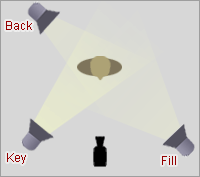
Basic Lighting: Three-Point Lighting and Using Reflectors

Three Point Lighting

Key Light
        The Key Light is the main and most obvious source of light. It would be something like a lamp, candle, light or other source that can be seen in the shot to make the viewer think that's the main source of light, the one that is lighting the scene.
Key, Fill and Back
Filler Light
        The Filler Light is the secondary source, usually placed behind the camera or the opposite side the the Key Light to eliminate shadows, like that on an actor's face if the light creates shadow.

Back Light
        The Back Light is the support source, like a window or open door to a brighter room/exterior. This is mainly used to add a three dimensional effect, like making the background look a distance from the object to show depth of a scene.

                 Reflectors
        Reflectors are used to reflect light at a subject, such as further eliminating shadows on a character's face, and can make certain points brighter and stand out more. They are in different sizes, which alter the amount of light reflected and how large the area lighted is, and are circular. They're packed in small round bags and open up when used.

 
Above: Class' 2-point lighting tutorial video